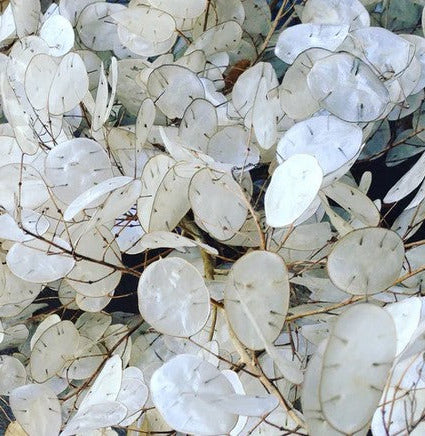
dried money tree leaves LUNARIA biennis (Money Plant) 1 oz (~1500 Seeds)
SKU: 51083121819
dried money tree leaves

dried money tree leaves LUNARIA biennis (Money Plant) 1 oz (~1500 Seeds)

Sale price$22.11 Regular price$24.57
Save 10%

Pay in installments of $6.14 with ShopPay, AfterPay and Klarna

Shipping Estimate
USA
  • USA
  • CAN

Ships within 48 hours · Estimated delivery Jun 29 - Jul 4

Promo Codes Available:

For Your Every Summer RSVP, with Code: SUMMER15

Description

dried money tree leaves LUNARIA biennis (Money Plant) 1 oz (~1500 Seeds)LUNARIA biennis (Money Plant) is a biennial flowering plant native to Europe and Western Asia. An old fashioned garden plant that is oftenly grown for the silvery white seed pods, looks like silver dollars. It is these coin shaped pods that make it attractive in dried floral arrangements. It is suitable for cultivation in a shady area or in a wild flower garden. Due to its dollar like shape, this flowering plant is named Money Plant. Money Plant is a

LUNARIA biennis (Money Plant) is a biennial flowering plant native to Europe and Western Asia.  An old fashioned garden plant that is oftenly grown for the silvery white seed pods, looks like silver dollars. It is these coin shaped pods that make it attractive in dried floral arrangements. It is suitable for cultivation in a shady area or in a wild flower garden. Due to its dollar like shape, this flowering plant is named Money-Plant.

Money Plant is a biennial plant, meaning it completes its lifecycle in two years. It belongs to the Brassicaceae family, which includes cabbage, mustard, and other flowering plants.

Money Plant grows as an upright, leafy plant with sturdy stems. In the first year, it primarily produces rosettes of large, heart-shaped leaves. In the second year, it sends up tall, erect stems with clusters of fragrant flowers. The flowers have four petals and are typically purple or lavender in color. After flowering, flat, round seed pods develop, which are silver-gray and papery, resembling coins or "money," hence the common name "Money Plant."

Money Plant typically blooms in late spring to early summer, generally between May and June. The blooming period may vary depending on the local climate and growing conditions.

Money Plant thrives in full sun to partial shade. It prefers well-draining soil and can tolerate various soil types, including sandy or loamy soils. It is relatively adaptable and can tolerate dry conditions once established.

Money Plant is popular for cottage gardens, wildflower areas, and naturalized landscapes. Its distinctive seed pods and silver-gray foliage add visual interest and can be used in dried flower arrangements. Money Plant is also known for its attractive foliage in the first year, making it suitable as a backdrop or filler plant in flower beds or borders.

Money Plant is an interesting and versatile plant that adds unique beauty and symbolism to gardens. Whether grown for its attractive foliage, charming flowers, or decorative seed pods, Money Plant can be an intriguing addition to the landscape.

Number of Seeds Max Coverage Area (Square Ft.)
1OZ 1,500 63
1/4LB 6,000 250
1/2LB 12,000 500
1LB 24,000 1,000
5LB 120,000 5,000
Shipping Notes
  • Free Standard Shipping on $100+ Orders to the USA.
  • Except Preorder products are shipped in 48 hours.
  • Delivery to the USA:
  1. Standard Shipping : 3-10 business days
  • If time is of the essence, please consider selecting expedited delivery for faster service.
Exchange/Return Notes
  • We offer a 30-day return/exchange service after receiving.
  • Final sale items are not eligible for returns or exchanges.
  • To process your return/exchange, please contact us at [email protected]
  • Please click here for more details>>> Return & Exchange Policy
SKU: 51083121819

Discover Niche Categories That Outsell dried money tree leaves

Top-Converting Item to Boost Your Average Order

4.5 ★★★★★
Based on 1810 reviews
Sort
Highest Rating
Newest First
Oldest First
Product Reviews
B
Verified Purchase
Becca
Louisville, US
★★★★★ 5
Poignant, truthful look at women as powerful, business-savvy, yet brutal slave owners
Format: Paperback
Women slave owners were the norm in the South, not the exception. They increased in numbers, stature, and power while the men were off fighting the Civil War. Women often owned the slaves, not the men and knew how to sign prenuptial agreements back then to insure they kept all their property (including slaves) upon divorce or death of their spouse. They traded and bought and sold slaves with business savvy that most men envied. And they could be just as brutal towards their slaves. Ironically, it was the ownership of other people that empowered these women to not be bound to their husbands.
WAS THIS REVIEW HELPFUL?YesReportShare
Reviewed in the United States on January 26, 2025
B
Verified Purchase
Brown David
Boise, US
★★★★★ 4
Good history, but not fun, engaging in popular literature.
Format: Paperback
The author is a very competent historian, and proves her points. She does so by stating each thesis and then reciting an exceedingly long string of supporting examples. Rinse and repeat. This is high quality, academic style history, but it’s not very engaging as popular literature. No one’s going to say “I couldn’t put it down.” That being said - I liked it! I learned a lot. Thanks.
WAS THIS REVIEW HELPFUL?YesReportShare
Reviewed in the United States on March 1, 2023
T
Verified Purchase
Tsukiko Brown
Lexington, US
★★★★★ 5
Should be required
Format: Paperback
In my opinion, this book should be required reading in high school/college history classes. It’s so important to learn accurate history when it comes to slavery and this book does that. White women played a larger role than we are taught. Please give this a read!
WAS THIS REVIEW HELPFUL?YesReportShare
Reviewed in the United States on October 23, 2025
S
Verified Purchase
shaleah newmam
West Palm Beach, US
★★★★★ 5
No regets
Format: Paperback
This was a good book to read! In school you only learn the male prospective during slavery! I know feel I can say white woman played a major role during slavery times. I like that fact that the Author put in the information to where we can go srwcah and read for ourselves. The visuals where an added touch. I feel like because alot of women of that time couldn't write so alot of information was missing. I feel like this is a must read.
WAS THIS REVIEW HELPFUL?YesReportShare
Reviewed in the United States on April 9, 2025
A
Verified Purchase
AuthorAnnaBella
Boise, US
★★★★★ 5
One of the most poignant books I have read in a long time.
Format: Paperback
One of the most poignant books I have read in a long time. “Southern communities, lawmakers, and courts recognized slave-owning women as individuals able to acquire and exercise mastery over enslaved people, s is evident from laws passed throughout the South. Laws dating back to the colonial period routinely recognized the mistresses owned enslaved people in their own right, and these same laws acknowledged the fact that these women were capable of exercising mastery over the enslaved people they owned.” Stephanie E. Jones - Rogers. They were referred to as Southern Belles’. Revered for their ladylike daintiness. But… there was nothing dainty about their dealings for they too, owned human property. These white southern mistresses were heavily involved and often owned more property than their male counterparts even being the breadwinners. These women were barbaric and wore the crown of cruelty. Dr. Rogers gave the enslaved a voice in this text – allowing our ancestors to share with us their story and experiences under the thumb of white mistresses. This text uncovers the extent of the involvement that white women had with slave ownership. There was discord in marriages due to white women struggles to maintain control of their financial gains of human property. These women utilized the judicial system to protect their pecuniary interests. The parents of these white girls/women bequeathed slaves to white females i.e. as young as newborns – which leads us to mistresses in the making – that is the education of young white women of the mastery of slave ownership. My heart broke as I was able to envision the accounts of atrocities inflicted upon our ancestors. Our people were raped and forced into being breeders and wet nurses to ensure the livelihood of these white mistresses and their families. The evidence is insurmountable in all the ways slave-owning women invested in, and profited from their financial ties to American slavery and its marketplace. Most importantly, there was testimony from formerly enslaved people of their experiences within slavery. This text is a mandatory read for all and in my opinion, must be included as part of the curriculum in schools.
WAS THIS REVIEW HELPFUL?YesReportShare
Reviewed in the United States on October 16, 2020

recommand products